Monday, December 1, 2008

Music Video Rhetorical Analysis


This video uses the rhetorical strategies of logos, pathos, and ethos. Each of these strategies shapes the video in every way. Without melding the strategies with his music the video wouldn't make sense. Most musicians are all about getting the ratings that allow them to make more money.

The video employs logos in the opening scenes of the video by using compare and contrast. He compares the life of an average fast food employee and that of a girl that is taken care of by him. He also employs description by telling the girl what he can get her if she is his girlfriend. He also uses cause and effect. He does this by saying if you are my girlfriend then you can have whatever you like. These implications of logos directly shape how T.I. puts his music video together.

The video appeals to pathos as well. The chorus appeals directly to pathos everytime that it appears in the lyrics and video. This is because money, diamonds, and expensive cars make everyone wish that was their life. It also has a sense of sexual appeal in it also. The clothes that the girl wears are awefully revealing. I know that girls also like to look at T.I. and drool over him. The video also appeals to pathos through the clothes that everyone wears. However I believe that the video exaggerates pathos by giving the audience a sense of false need. The lyrics say that you necessarily need diamonds, money, and expensive cars to survive in this world.

The video appeals to ethos along with logos and pathos. The appeal to ethos is seen in the products that T.I. promises his new girlfriend. All of the goods are made by brands that are typically of higher quality. These include Lamberguini and Rolls Royce. These brands are considered to be the highest quality of their products. These things appeal to the ethos of the video.

T.I.

Tuesday, November 25, 2008

Post #15 Music Video


This video and song directly relates to how I view things in my life. I try to make myself the, "Shining star," in everything I do. I also aspire to, "Go far," in all my sports, studies, and all other aspects of life. The song tells you to live your life. That's exactly what I do. I don't worry about anyone elses life and focus on mine. The harder I work the more benefits that I can reap. The more benefits the better quality of life that I can achieve. However, I don't try to make everyone know who I am. I like to know that people are watching me and noticing what I'm doing. Never do I let that go to my head, I just pass off events that occur in sports and school as anyone could've done it just as good or better then I. Those that are caught up in making their money are those that live life only to make make money and do nothing else. Most of them are involved in things that are illegal like Micheal Vick in dog fighting and countless others in steroid abuse. Money does crazy things to people. It makes them unlike their normal personality. I leave all those distractions on the field. Once I leave the playing field I don't think about my accomplishments I relish in the teams accomplishment. The best players are the ones that are team players. This video and song describe me very well both how I am and how I'm not. It also shows us how people caught up in all those things can act. They can act out of greed and personal motivation to get what they want. I am one that shines and one that goes far but I'm not one that steps on those that helped get me where I am today.

T.I.

Post #14 Music Video


This video is edited in a way that connects the video to the lyrics of the song itself as is common in most music videos. The lighting for this song is bright and vibrant because the song is about having everything that you could ever want. When you associate having everything you could ever dream of you are often happy during the thought process. General happy thoughts are thought of as bright colors, this is why T.I. and his producers choose to set this video in the sunlight. Another way that the lighting is used to set the tone in the video is the dinner scene. Sunset is often seen as one of the most romantic times of the day. T.I. must believe this because he chooses to have dinner with his new girlfriend at sunset which sets the mood for the rest of the video. The audio and visual aspects of this video go hand in hand with one another. The visuals often take cues from the lyrics. When T.I. says, "Stacks on you," an image of a stack of $100 dollar bills is shown on the screen. There are many patterns in this video including: the chorus scenes, his girlfriend telling other guys to leave her alone, and the pool in the background. In the chorus T.I. repeats the words just like all songs do and the images that are associated with the chorus at the beginning are the exact same images every time the chorus is sung. T.I.'s girlfriend is constantly bothered by other men, however, he gives her everything she wants there for she always sends them away. Every time it's a different guy. Finally the T.I. is pictured in front of a pool for each verse of the song. I'm not sure why this is but every time he starts a new verse he is standing in front of the pool. From these examples you can tell that the video is composed of many different elements that with just one the video wouldn't be complete.

T.I.

Sunday, November 16, 2008

Laocoon and his Rhetoric


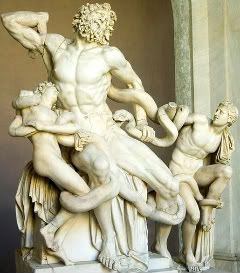
The Laocoon Group is a story from the Hellenistic culture during the ancient Greek period of domination over the world. The story of the Laocoon Group is a common mythological story told from the ancient Greek world. Laocoon played a small role in the beginning of the Trojan War. He was the son of Capys, the brother of Anchises, and priest of Poseidon. Laocoon was the person responsible for warning the Trojan’s about allowing the Trojan Horse within the walls of the city of Troy. He is then said to have thrown his spear at the horse. For his action a giant serpent is sent to kill him. It is said that the goddess Athena is the one responsible for sending the serpent to kill Laocoon and his two sons. At the end of the story the Trojan Horse is allowed into the city where Greeks hiding inside the Horse jump out and sack the entire city of Troy.

The Greeks lived in a world dominated by myth and worship. They worshiped gods that represent phenomena that surrounded them in everyday life. These gods included: Zeus, King of the Gods, Hera, the Goddess of Marriage, and Poseidon, the God of the Sea, and Hades, God of the Underworld. Each God or Goddess had his or her own place that they ruled with complete dominance. Often times these great powers clashed and war would break out on Earth. There was a symbol given to each of the Gods to help identify them. When all the Gods needed to meet, their meeting place was atop Mt. Olympus, near the city of Olympia. These Gods dominated the first part of Greek culture and began to fade as free human thought began to develop.

The statue of Laocoon and his sons’ deaths has been created in two versions. First it was created in fine marble by the Greeks and later copied by the Romans in bronze. Marble is the term used for any type of rock that takes on a highly polished look. Bronze is a mixture of copper and tin that is highly prone to seawater corrosion. One possible explanation for the change from marble to copper is the availability of marble on the Greek mainland and on their surrounding islands. Marble wasn’t readily available to the Romans; therefore they switched to using Bronze to construct their sculptures.

Sculptures can conceal hidden meanings, messages, and themes. The statue of the Laocoon Group uses logos, pathos, and ethos to conceptualize the decision making of humans in times of war. The sculpture of the Laocoon Group expresses the growth of human artistic abilities by applying the strategies of logos, pathos, and ethos. Each of these traits is expressed in different aspects of the sculpture itself. These appeals directly affect how the art we see today was invented. From each of these strategies we can see how human artistic abilities and styles have been shaped from the beginning of artistry by logos, pathos, and ethos.

The rhetorical appeal to logos is applied in the sculpture through narration, classification and division, compare and contrast, and either/or. From these you can fully appreciate the sculpture in its entirety. The appeal by narration of the story is strictly dynamic. The story is constantly changing and sculpting the picture in our mind. This essentially shows us a certain point of time in which this sculpture is depicting. This gives us an extraction of the story of Laocoon. An extraction is an example of classification and division and aids the appeal to logos. The extraction is static unlike the story it doesn’t change and only tells us about a certain space in the story. The story and the extraction set up a binary of either/or. You can look at the sculpture and as dynamic, or looking at the whole story or you can look at it as static and only see the specific moment in the story that the sculpture is depicting. Finally, the last rhetorical appeal to logos used in this painting is compare and contrast. This is used in the mythological story of Laocoon and the realism of the sculpture itself. A mythological story is made up however the sculpture has a certain realism about it that makes you think that the artist had to be watching Laocoon and his son die to make such a life like sculpture. Logical appeal is all over in this sculpture whether it is obvious or hidden.

The sculpture also has a strong appeal to pathos. The static, extraction from the story of Laocoon shows emotions expressed on their faces make you feel a sense of compassion for them as you see them starting to draw their final breaths. There is also a sense of sympathy for Laocoon’s kids because their fate wasn’t decided by any choice they had made and they must watch their father die before they lose their lives as well. In this sculpture there is also the possibility of some sex appeal going on. None of the characters in the sculpture are wearing any clothes with the exception of a leaf covering their genitals. However I don’t think that this was the original intent of the sculptor it is a possible use of pathos. In the sculpture I believe the artist also tried to incorporate the scare tactic by showing that if you enrage the gods you will pay with your life. These pathetic structures are used to make the viewer feel for those that are suffering in the sculpture.

Ethos is also at work among the other elements of this sculpture. In this sculpture ethos has been used to show what happens to traitors. Laocoon was a traitor to the soldiers of Greece and the Athenian Goddess Athena. He crossed them and paid with the ultimate price…his life. In ancient Greece this sculpture of the story of Laocoon would’ve been similar to seeing a famous face on your television set. Every child, teen, and adult knew the story of Laocoon and his family and what they had done to earn the fate. In those days the story of Laocoon was as famous as any sport’s athlete in America. The element of ethos is hidden somewhat from the common viewer. However if we examine the credibility of the sculpture we will see that Laocoon damaged his credibility by giving out the information that he knew. The dynamic, story and the static, sculpture itself show misuse of ethos by the use of ad hominem. They attack Laocoon’s actions rather than attack the Greeks for planning a sneak attack on the Trojans. You must have a little bit of background information to pick out these subtleties in this sculpture.

From each of the three strategies above; logos, pathos, and ethos, it is evident that human decision making during times of war can lead to undesired outcomes, as is the case for Laocoon and his two sons. They meet a very unpleasant end for the decision that Laocoon made. Betraying those that raised you is never a good idea. Traitorous deeds have awful consequences that no one wants to consider because they never think that they will ever be caught. From the sculpture depicting the end of Laocoon’s life we can see how far artistry has come from the stiff, blocky sculptures of the Egyptians and Mesopotamians.

T.I.

Sunday, November 9, 2008

Post #13 Cultural Context

Photobucket


This political cartoon is drawn to indicate a possible exit plan for our troops in Iraq. However it seems that in the past year or so that Iran has become a threat to the world. This may have just provided the United States with a removal plan for the troops still in Iraq. However, this plan doesn't necessarily state that the troops will be coming back to America. More than likely they are looking at a tour of duty in Iran.

A timeline for the withdrawal of U.S. troops in Iraq has been a major concern for all during the Presidential election over the past year. It has been a hot topic in the Senate and the House of Representatives as well. Senator McCain was highly criticized for his plan for a timeline bill he supported. This timeline proposal has split Americans in half. Some want a hasty retreat out of Iraq while others call this a statistical loss. Either way you look at it someday we will have to pull our troops out of Iraq.

At a time when peace seems to be coming to the land of Iraq and things are starting to calm down a new crisis is rising. The Iraqi War has cost the United States money and lives. Now not as many lives are being lost in Iraq and people are starting to call for a withdraw of troops. However while this recall has been tossed around a new power or threat has risen. This power lies within the country of Iran.

Most of the tension between Iran and the United States comes mostly from the fact that Iran mastered a crucial step to producing nuclear weapons. A new leader has also helped to fuel the tension between the two countries, Mahmoud Ahmadinejad. He won the election for ruler of Iran in 2005. Ahmadinejad says, "If it weren't for American interference in the Middle East then there wouldn't be any stress between the nations." However he also says, "Both countries are seeking dignity, respect,and perfection." He soon became the face of defiance of the nuclear programs of the United States. The most shocking statement that Ahmadinejad said was, "The holocaust was a myth." This further enraged the U.S. and the entire world.

This cartoon symbolizes that America wants to pull its troops out of Iraq, where we have done much to save their country from it's hostile leader, Saddam Husein. Once we started to consider a timetable for troop withdrawal a new enemy poked it's head out from right next to Iraq, Iran. There is a possibility for hostilities to escalate and force the U.S. to move its troops right out of Iraq and into Iran.

For more information on what Ahmadinejad thinks and says about life and politics view his personal blog.

I'd like to give credit to the writers, photographers, and editors of the New York Times and to Mahmoud Ahmadinejad, himself for the information in this Blog Post.

T.I.