Sunday, October 26, 2008

Post #10 Vice Presidential Debate


The first way that Sarah Palin appeals to logos in her rebuttal to Joe Biden's answer to the question is when she says, "The good thing about working with Senator McCain is that he doesn't tell one group one thing and a different group another thing." This appeals to logos because why would you do something like that. It would be unethical and it would eventually bring his whole campaign to a screeching halt. Another way in which she appeals to logos is when she talks about the energy bill that Barak Obama voted for. She says, "That bill that your running mate voted for is what gave the oil companies that big tax break." This is absolutely crazy because the oil companies don't need a tax break. They don't need any tax breaks they are having record profits yearly with the inflated price of gas. This may also appeal to pathos in some degree because is also sides with the grievances that the American public is having with rising gas prices. She says that she told the oil companies in her state that they weren't going to get the relief of those tax breaks because she deemed it unnecessary. She wanted some of that money that they were gaining so rapidly to be given back to the people of Alaska. She also applies to this style of rhetoric when she says, "There is nothing that I have promised that I would take back because of the financial crisis we're in....and I don't think that John McCain has made any promises that he would take back either." This is because they shouldn't have to take anything off of their campaign because of the financial crisis. They should be able to complete things that are necessary for our country at a low cost. They can get things done quickly and efficiently.

There is another aspect that I think is worth mentioning here and that is the appearance of Sarah Palin. Notice that she is wearing a United States flag pinned to her suit jacket. I think this implies a little bit of pathos and ethos. This suggests pathos because she is an American citizen like all the people she is trying to represent in the White House. I think that it suggest ethos because she is trying to convey to the people that she is a true American and only votes for things that are helpful and necessary for the people of the United States of America.

I think that these things are essential to the speeches that these candidates give because they inform the people on the issues and what side that each candidate represents. Without appealing to logos, pathos, and ethos they would never be able to successfully get their opinion and point across. The use of these three types of rhetoric are evidence that often times propaganda is used to sway our votes. People's minds can be swayed easily by certain expressions of rhetoric. Often times what these candidates are telling us is totally and fully propaganda to get us to vote for them and not the other candidate. They may not even believe in what they are saying. This is why it is important for you, as a good voter, to research about each candidate so that you can see what they truly believe in so that you can make an informed vote.

T.I.

Tuesday, October 21, 2008

Post #9 Presidential Debate


Senator McCain appeals to logos over this issue when he says, "We can offshore drill now, we've got to do it now, we'll reduce the cost of a barrel of oil because we show the rest of the world we have a supply of our own." This appeals to logos because it's logical that we use our own oil that we can harvest from our own land to reduce the price of our rapidly rising gas prices. Gas prices hamper many people who drive gas-guzzling vehicles to and from work. He also appeals to logos when he talks about free trade. He says, "It costs our companies a billion dollars to get their goods into Colombia but it's free for their companies to get their goods into our country." Does that make any sense at all? Why should our companies pay that much if theirs aren't? Senator Obama appeals to logos when he responds by saying, "We've got to have a president who recognizes the benefits of free trade but is also going to enforce unfair trade agreements and is going to stand up to other countries." Logos is used here because it makes sense that a president should support the ones that are fair and stop the ones that are unfair. If it is unfair then someone isn't benefiting and it should be where both partners are benefiting. He also uses logos when he says, "We must also hold them (the auto industry) accountable to start producing the highly fuel efficient cars of the future." Who better to hold accountable than the people building our cars? They are the ones that can save us from high gas prices by creating cars that don't use as much gas. He also uses logos when he mentions the building of wind turbines and solar panels to create more energy.

Senator McCain appeals to pathos when he talks about the rising gas prices because Americans are feeling like they won't be able to afford their gas bills eventually. He sympathizes with the American people saying, "If we start drilling offshore we can lower gas prices." Senator Obama uses pathos when he says, "Transportation accounts for 30% of our total enegy consumption." This is because he also sympathizes with the American people and their energy bills. He also uses it when he says, "It will creat 5,000 jobs in the midwest where we can re-tool these plants and create wind farms and solar farms," because he feels for the people that can't get a job because companies are having to make cutbacks because they are losing money.

Both candidates appeal to ethoes when they talk about each other. They criticize each others view points and actions calling each other liers and hypocrites. They talk down to each other as if they have nothing in common what-so-ever and like they aren't worthy of being president. They say that because of the way that they voted on certain bills is the way they think on certain issues. Often times they only disagree with only certain parts of the bill but agree with the overall concept of the bill. They use ethos in a degrading way towards one another.

The context of this event is to tell the audience what each candidate believes on certain issues. Often times these views are masked by the continuous criticizing of one another. They spend too much time tell the audience why the other person is unworthy of being president rather than telling why they should be president. If they took more time telling us why they are the better candidate then more would come out of these debates. The real facts have to be looked up on the internet if someone wants to know the true facts. If someone can find out all the facts from one of these debates then they are a politcal genious. In any case in these debates regularly appeal to logos, pathos, and ethos because they are very effective means of getting points across to different groups of people.

T.I.

Wednesday, October 15, 2008

Post #8 Rhetoric Questions

Chapter 1

1. If the discipline of rhetoric is just emerging then how can we account for Aristotle giving it a characteristic and Hitler used it so very well?

2. When rhetoric is used in speeches from politicians how can we know what they're saying is the truth?

3. How does an author get his/her true point across when you have all these different interpretations of their writing floating about?

Chapter 2

1. If there are disclaimers like, "These results not typical." present in adds then how is it that they can be effective?

2. Can we look at issues of authority over evidence in other ways? Such as politicians or ads that have these results not typical in them.

3. Does rhetoric only deal with advertisements and comics? What else can it be used for? What other value does it have?

T.I.

Tuesday, October 7, 2008

Experiencing the Zoo


The minute I stepped out of my car I could hear the distinct sounds of monkeys hooting and hollering as they played amongst each other. Without warning, an ear piercing whistle blows very close to where I parked my car. The Lincoln Children’s Zoo Train thunders past, just feet from the parking lot. As I approached the gates, I could hear music that put a spring in my step as I went to investigate this new zoo. At the gate, the lady said, “Just one?” I replied with a hushed, “Yes,” as I unwillingly handed her my hard earned money. As I entered the main area of the zoo, the first thing I encountered was the map. I took a close look at the map to see where the animals that interested me most were located in this unfamiliar zoo.

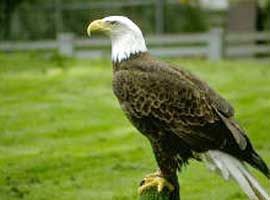
The first animal exhibit I encountered on my stroll through the zoo was the Bald Eagle exhibit. The exhibit was a very small enclosure. To reach the viewing area, you had to open a door. Inside this door, was an area to listen to the calls that Bald Eagles make when communicating with each other. Beyond this feature, there was another door through which you stepped to stand on the viewing area for this exhibit. Inside the habitat, sat two majestic and beautiful Bald Eagles. Both sat on a make shift nest that had been created by the zoo staff. Next to the nest, was a shelter for the eagles to use during harsh weather conditions. A member of the zoo staff stepped onto the viewing area with me and said, “Isn’t it sad, to see these beautiful birds just sitting in here?” At first I was taken back by the stranger’s comments but finally I mustered a reply, “It’s very sad. How did these two get here?” He replied quickly, “These two have been hurt in the wild. One was shot and lost part of its wing and the other was injured and will never be able to survive in the wild.” I stood there and look at the beautiful birds for a while not saying anything. Finally I commented, “A bird as majestic as these shouldn’t be subject to that type of human abuse.” The young man told me, “It happens all the time.” I told the man thank you for sharing that information with me and moved on to the next exhibit on my list to visit.

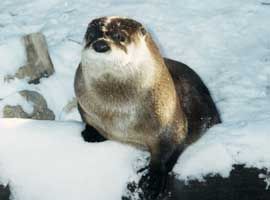
As I approached the tank to view the River Otter, I saw him swimming laps, gracefully in his pool. Every once in a while he would pop his head out of the water to catch a breath of air. He would swim from the edge of the water, under a log in the pool, and then push himself off the side wall headed back to the edge of the water where he would immediately start his paddling again. As he swam, he streamlined his body and used his powerful hind legs to propel himself swiftly through the water. As I watched him swim his laps, something caught my eye near the front of his tank. It was a dull red ball that had multiple, small tooth marks on it from playful bites provided by the otter. He seemed uninterested in the ball and more interested in watching what the passersby and I were doing. Every time he swam passed the glass, he would look out at the people and children walking by adn then glance at me sitting and watching. As I got up and decided to move on to another exhibit, the playful otter got out of the water and followed me to the opposite side of his enclosure. Maybe he was asking me to stay and watch his beautiful swimming techniques. He slowly turned and got back into the pool, he realized that I wasn’t going to return to my resting place where I had watched him swim multiple laps around his pool ealier.

From the Otter pool I moved to the area of the zoo called the First Hand Farm. The First Hand Farm had a strong smell that could be easily associated with any farm, that of manure. It was putrid and hung in the air and masked any good scent in the area. The smell was almost overwhelming. There were a lot of things for younger kids to do in this area. First of all, everyone could feel the texture of pelts from the different kinds of animals. The kids could have animal tattoos painted on their faces for fifty cents. Kids could enjoy a leisurely ride on a donkey or horse of their choice for a small fee. Also in the First Hand Farm, there were enclosures for animals such as goats, llamas, chickens, donkeys, and horses. There were four enclosures, three of them held chickens, llamas, and goats, and the fourth held the horses and donkeys. Between the three enclosures holding the chickens, llamas, and goats a wooden walking bridge had been erected for the goats to cross back and forth between the different enclosures. Most of the goats preferred to sit and sun on the walkway, while others walked over them between the different pens. On the floor of the enclosures, goats herded around little openings in the fence where kids could feed them by hand and pet them. For fifty cents, one could purchase food pellets that the goats consumed rather quickly and looked at the children pleadingly for more. The kids turned to ask their parents for two more quarters. The human kids ran to and from their parents very quickly, almost at a dead sprint, back to the little machine that dispensed the pellets. The First Hand Farm was very child oriented and fit the zoo well. The kids got a little overwhelming after a while and I decided to move on to other exhibits in the zoo that might be a little more interesting to me.

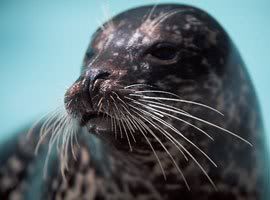
The next exhibit that caught my attention was the Harbor Seal pool. Two seals were swimming quick laps around the pool only pausing to take momentary breaths of air. They used their powerful tails and flippers to propel themselves about the pool. As I sat on the bench and watched them swim their numerous laps, I could hear the sound of waves crashing against the shore and other seals barking. I looked around to see a speaker placed on top of the pool house just beyond the enclosure. In the center of the pool was a rock for the seals to bask in the sun on. On this beautiful summer day, neither was interested in sitting and enjoying the sun. They were both enjoying their dip in the pool. As I sat watching the seals, there was something in the bushes that caught my eye. It was a bird, not just a common sparrow that you see every day but a big bird.

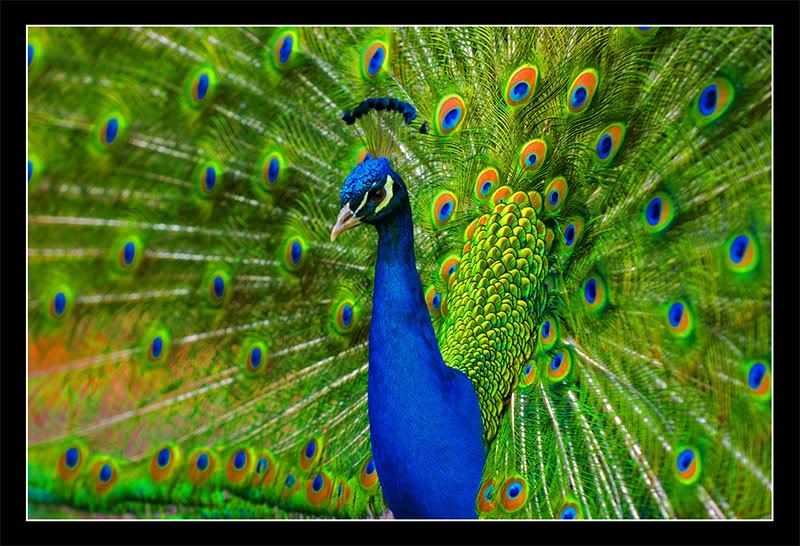
It took me less than a minute to realize what that bird was that I was looking at, it was a peacock. Actually it was two peacocks, one male and one female. The male had its big, long train of blue, black, and green feathers flowing behind it, while the female was plain brown. The male seemed intent on trying to catch the female’s attention, slowly moving towards her as she ate. He tried everything except spreading his giant fan of feathers, his signature mating call. A small boy walked by and startled the male and he gave out a loud call that could be heard throughout the park. Then a pesky squirrel caught my attention, as he hurriedly ran across the path in front of a group of people walking between exhibits. I noticed that he had a nut in his mouth as he ran. He stopped once he reached the other side of the path as if to pray to God, thanking him for allowing him to cross without becoming road kill. After his quick prayer, he proceeded to the base of a tree trunk and began to dig a hole in which to bury his newly found nut. He dug for a minute or so and decided that the hole was deep enough and carefully placed the nut inside the hole and covered it with dirt. There were also various other birds that were allowed to roam free about the park. Small food dishes had been set out sporadically about the park for these birds to eat.

As I sat there and watched all these animals scurry back and forth, I began to think about how these animals ended up here. This made me wonder how the zoo keepers had decided what animals could wander freely throughout the park. Are all these animals, just like the bald eagles, here because they can’t survive in the wild on their own? I also began to think about how this zoo was different than other zoos that I had visited in the past, including the Henry Doorly Zoo in Omaha and the San Diego Zoo. It made me question the institutional values of zoos and if they were limited by their monetary resources.


The peacocks and other birds are allowed to roam free because they can’t fly; their wings have been clipped or injured. Allowing some critters to roam free adds a feeling of freedom to the zoo. With animals that roam freely, we can see how they interact with people in the zoo. The zoo can’t allow all the other animals to roam the park because they would be a liability to the guests. Birds and squirrels don’t pose a threat because most often times they run when near a human. These decisions make the most sense; if animals like the leopard were allowed to move about freely, there would be injuries and deaths in the park, both human and animal. No zoo wants to deal with problems like that.

Quite a few of the animals that end up in zoos or preserves are the ones that have been injured so severely, that they wouldn’t be able to survive on their own any more. Like the bald eagles, many have injuries that limit their abilities to survive in the wild. Those two bald eagles can’t fly anymore which wouldn't allow them to hunt to survive and they'd be easy prey for predators, like wolves or foxes. If you can’t survive in the wild then there is no better place than a zoo to keep you safe, feed you, and provide you with a shelter. Each animal is brought to a zoo for different reasons. Whether they are injured or endangered species, these animals should feel as they have been given a second life.

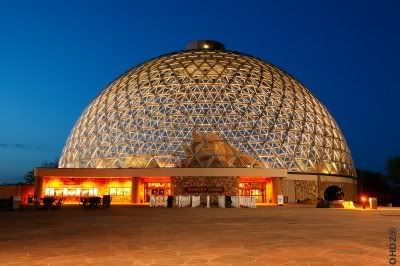
I began to compare this zoo to the others that I had visited. This one was much smaller and had fewer exhibits than the others I had visited. Compared to the Henry Doorly Zoo in Omaha, the Lincoln Children’s Zoo was merely a petting zoo. It has less interactive things for people to do and the exhibits were less appealing and less dramatic. The Lincoln zoo was directed more towards kids than it was towards adults. Other zoos, try to aim for audiences of all ages, with exhibits that just blow your mind like the Desert Dome in Omaha or the elephant shows put on by the animals and zoo keepers at the San Diego Zoo. In part, I think these differences are directly affected by the available funding available . Money can bring certain animals to a zoo (like the Chinese pandads) and it can produce exhibits of higher quality. These high quality exhibits bring more and more people into the zoo to see these exhibits. Money also allows a zoo to provide better care to animals, provide better living conditions within the cages with more toys or more realistic environments, and hopefully these will provide a better situation for the animals . This zoo ranks poorly among other zoos across the nation mainly due to the audience that it draws and because of monetary issues.

Finally I began to wonder about the institution of a zoo. Was it solely for the entertainment of our youth or is there more behind the reasons for zoos? Zoos keep younger kids relatively entertained and they wear them out pretty easily. I believe there is another reason for zoos, one that is often over looked. These places are a center for learning; they can teach you about all the different species that are kept behind those bars. They can tell you interesting facts about animals you may never get the chance to learn about or see in your lifetime. Zoos provide us with a great place to gain knowledge about things that are unfamiliar to us. They are a fundamental learning site for us and the younger generations.


T.I.

Cubing Exercise

1. The cages that animals in the zoo are housed in are small and constricting. It suggests that zoo animals are for only our entertainment that they have no greater purpose. It also suggests to me that the cages these animals live in are too small for them to live comfortably. They should be luxurious with lots of room for animals to roam and play as they please. People in general take these animals for granted. They aren’t just for our entertainment; they are an educational resource as well.

2. The reindeer exhibit at the Lincoln Children’s Zoo is just big enough for the reindeer to make one lap around the enclosure in under a minute. There is no room for him to run about or play. The seal take hardly fits the two seals when swimming at the same time. They have to swim in a single file line to make room for one another. Their rock perch in the middle of the water has only enough room for the two of them to lie nearly on top of one another.

3. A kennel for dogs could be compared to my subject. A kennel has many small cages but for only one type of animal unlike the zoo where they have small cages for many types of animals. The animals in the zoo don’t get the proper amount of exercise and neither do the dogs in a kennel. However, the dogs are walked by workers at the kennel. Animals at the zoo don’t enjoy this leisure.

4. If animal habitats were built larger and species were mixed then a zoo would be much more interesting. The more interaction between animals the more people want to come to the zoo. With every animal separated from one another there is no interaction. Each animal must do something on its own to catch everyone’s attention. Larger exhibits with more inhabitants would reel in a bigger audience.

5. My subject is made of different enclosures with different animals in each enclosure. Each animal isn’t related to the next. However in certain buildings or areas animals may be related to one another. The monkeys might be located in a certain portion of the park and the reptiles might be housed in a specific building. Without each of these pieces the zoo isn’t worth coming to see. Certain animals bring in different audiences. Each animal is equally important as the one right next to him.

6. You can act on it by doing something about the living conditions of the animals in zoos. Tell someone that the habitats are too small and that animals are social and need friends. This will make the park much more enjoyable. People like to see animals interacting with one another. There is always a cluster of people around an exhibit when two or more of the animals are doing something worth watching.

T.I.